Questions Every Voter Should Have Answered About the November Operating Millage Proposal

Updated: Jul 15
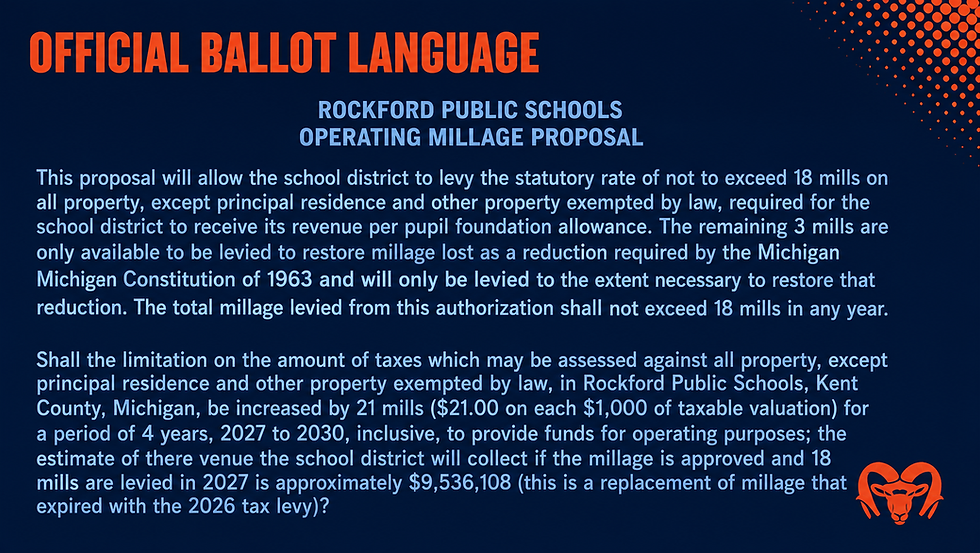
As I continue meeting with members of our community, one thing has become increasingly clear: people want information. Regardless of how someone ultimately votes this November, they deserve to understand exactly what they are being asked to approve.
During the July 13 Rockford Board of Education meeting, the Board voted to place the Headlee restoration and operating millage together as a single ballot proposal. District leadership explained why they believed combining the two measures into one question was the best approach and also stated that if the proposal is not approved, program reductions may become necessary.
That decision raises several important questions that I believe voters deserve to have answered before casting their ballots.
What does "operating purposes" actually mean?
The ballot language states that the millage will provide funding for operating purposes. While that describes the general purpose, many voters may reasonably want additional detail.
For example:
What specific operating expenses are expected to be funded?
Which programs or services rely on this revenue?
Are there legal restrictions on how these funds may be used?
How will the district ensure accountability if voters approve the proposal?
Clear answers help voters understand not only what they're funding today, but also how those dollars may be used throughout the life of the millage.
Why Combine the Proposals?
The Board voted to place the Headlee restoration and operating millage together as a single ballot proposal rather than allowing voters to consider each question separately.
During the Board discussion, district leadership and the district's public relations firm explained that they believed combining the proposals into a single ballot question would make the proposal easier for voters to understand. They also referenced the previous bond proposal, stating that, in their view, voters had difficulty understanding it when it was presented and that this contributed to its defeat.
I believe this raises an important discussion for our community.
Our community has consistently demonstrated the ability to evaluate complex issues when provided with clear, complete information. Many voters may reasonably prefer the opportunity to consider each proposal on its own merits rather than being asked to make an all-or-nothing decision.
I respectfully disagree with the premise that voters cannot evaluate two separate questions. Our community is more than capable of considering multiple issues when they have clear, transparent information. Providing voters with separate proposals allows them to evaluate each on its own merits and make the decisions they believe are in the best interest of our schools and community without limiting their ability to make independent choices.
Ultimately, whether combining proposals is the best approach is a decision each voter can evaluate for themselves.
What happens if the proposal doesn't pass?
During the Board discussion, district leadership stated that failure of the proposal could require reductions in programs or services.
That naturally leads to additional questions:
Which programs could be affected?
What alternatives have been evaluated?
What cost-saving measures have already been considered?
Would the Board return with a revised proposal if this one is unsuccessful?
Understanding these possibilities helps voters evaluate both the immediate and long-term implications of the election.
Looking Beyond This Election
The decisions made this November may influence more than this year's budget.
They may also shape how future ballot proposals are presented and how the district approaches major financial decisions. Whether someone believes combining proposals is appropriate or prefers separate questions, that discussion is an important part of good governance.
Open dialogue, clear financial information, and transparent decision-making help build public trust regardless of the outcome.
An Informed Community Makes Better Decisions
Every voter will ultimately decide how to vote based on their own priorities and understanding of the issues.
My hope is simply that those decisions are made with as much information as possible.
I encourage everyone to:
Read the ballot language.
Review the Board packet.
Watch the Board discussion.
Ask questions.
Vote based on the facts and the answers provided.
An informed community is one of our greatest strengths, and thoughtful public discussion benefits our students, our taxpayers, and our district.
These are the kinds of questions voters deserve to have answered before casting their ballots. Regardless of where each of us ultimately stands on this proposal, an informed community is better equipped to make thoughtful decisions. Our students, taxpayers, and district all benefit when decisions are made with clear, complete, and transparent information.
Sources
Rockford Public Schools Board of Education
July 13, 2026 Board Meeting Agenda, Board Packet, Proposed Ballot Language, and Board Discussion regarding the November Operating Millage and Headlee Restoration Proposal.
Michigan Constitution of 1963
Article IX, Section 31 (Headlee Amendment) – Property tax limitation provisions.
Michigan Legislature
General Property Tax Act (MCL 211.24f) – Ballot language requirements for millage proposals.
Michigan Department of Treasury
Millage Reduction Fraction ("Headlee") reporting forms and guidance explaining Headlee rollback calculations and maximum allowable millage levies.
Rochester Community School District
Non-Homestead Operating Millage Proposal Information (FAQ) – Background explaining Michigan's 18-mill operating levy on non-homestead property, renewal of operating millage, and restoration of millage reduced by the Headlee Amendment.
Example Michigan School District Ballot Language
Warren Consolidated Schools 2024 Operating Millage Replacement Proposal illustrating combined renewal, restoration, and protection against future Headlee rollbacks.
Note: This article reflects my review of the publicly available Board packet, proposed ballot language, applicable Michigan law, and publicly available school finance resources. My intent is to encourage informed discussion and to ask questions that I believe voters deserve to have answered before casting their ballots.



Comments